How Stake Crypto Banking Works
Stake runs a crypto-first cashier. Your balance sits in a wallet inside your Stake account, in the coin you deposited, and every deposit and withdrawal moves as a transfer between that balance and your own crypto wallet or exchange.
A deposit starts in the Wallet menu. You pick a coin and a network, copy the deposit address Stake shows, and send funds to it. A network is the blockchain that carries the payment. USDT, for example, can travel on Tron, Ethereum and several other chains, each with its own fees and speed. Stake credits your balance once the network has confirmed the transfer.
A withdrawal runs the same road in reverse, in five steps:
- Withdrawal request. You choose the coin, network, amount and destination address, then confirm with a two-factor code, an email code or your social login.
- Casino approval. Stake approves the request. Stake's help center says larger amounts may need manual processing by its staff.
- Transaction sent. Stake broadcasts the payment. This is an on-chain transfer, meaning it moves on the coin's own public blockchain rather than inside Stake's books. Each transfer gets a TXID (transaction ID), a public reference number you can look up on a blockchain explorer.
- Blockchain confirmation. The network confirms the payment. A confirmation is the network's record that the transfer is final, and wallets differ in how many they wait for.
- Funds arrive. The coins become spendable in your wallet.
Stake controls steps 2 and 3. After that, the speed depends on the network and on your wallet or exchange. Every timing figure on this page describes the casino's part, the network's part, or both added together.
Deposit Methods and Supported Crypto
Stake lists its supported coins and networks in its help center. The main ones are below.
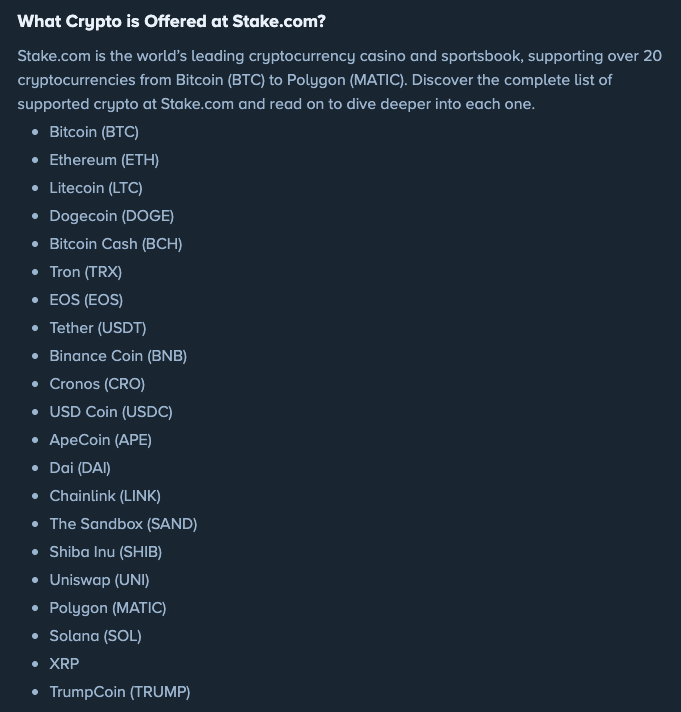
USDT and USDC are stablecoins designed to track the US dollar, so they avoid the same price swings as assets such as BTC and ETH. ERC-20, TRC-20 and BEP-20 are token standards on Ethereum, Tron and BNB Chain. Stake says coins sent on an unsupported network will not be credited, and XRP and EOS deposits also need the memo or destination tag Stake shows, a short code that identifies your account.
Stake's help center says there is no maximum crypto deposit, and that deposits under $0.01 cannot be processed automatically. Sending a deposit costs the network fee your wallet charges.
Stake's terms require you to wager 100% of each deposit before a crypto withdrawal. A deposit withdrawn with no bets placed is treated as invalid. In our 450 USDT TRC-20 deposit test, the transaction received its on-chain confirmation after 5 minutes 3 seconds. Stake credited our casino balance 2 minutes 30 seconds later.
How Long Do Stake Withdrawals Take?
Stake publishes no fixed approval time. Its help center describes the stages a crypto withdrawal passes through and who controls each one, and says that larger withdrawals may require manual processing, which can add a temporary hold.
| Stage | Who controls it | What Stake publishes |
|---|---|---|
| Request | You | Email verification first, then a two-factor code, email code or social login to confirm |
| Approval | Stake | Larger withdrawals may require manual processing by Stake's administrators |
| Verification | Stake | Additional KYC can apply to any withdrawal |
| Blockchain confirmation | The network | Every transaction must be confirmed before it is credited, and wallets require different numbers of confirmations |
| Arrival | Your wallet or exchange | Funds are sent to the wallet address you enter |
Approval and any additional verification make up Stake's part of the wait. Once Stake has sent the payment, the remaining time depends on the network you chose and on how many confirmations your wallet or exchange waits for.
Two things can move a withdrawal from the fast lane to the slow one: its size, and whether Stake asks for more verification. Both sit in Stake's stages. A slow network adds time after the payment is sent, not before it.
What the Casino Claims vs What We Observed
The table sets Stake's published process next to our test.
| Evidence | Crypto-network | Result | KYC | Source |
|---|---|---|---|---|
| Stake's help center and terms | All crypto | Larger withdrawals may be processed manually | Additional KYC can apply to any withdrawal | Operator-stated |
| Signup | Not applicable | Account opened with email, username and password | None requested | Tested by us |
| Deposit, 450 USDT | USDT on TRC-20 | On-chain confirmation: 5 min 3 s; Stake credit: 2 min 30 s later | None requested | Tested by us |
| Withdrawal approval | USDT on TRC-20 | Approved and TXID issued 32 s after we submitted | None requested | Tested by us |
| Withdrawal arrival | USDT on TRC-20 | First confirmation and wallet credit 2 min 25 s after we submitted | None requested | Tested by us |
| Amount received | USDT on TRC-20 | Requested 518.20 USDT, received 517.20 USDT | None requested | Tested by us |
We ran this test on September 2, 2026, with one account and no bonus active. We deposited 450 USDT on TRC-20, played for a little over two hours, and withdrew 518.20 USDT. Stake asked for no identity documents at any point.
Times run from the moment we submitted the withdrawal. Stake approved the withdrawal and issued the TXID 32 seconds after we submitted the request. The first blockchain confirmation came 1 minute 53 seconds later, and our wallet was credited at the same point, 2 minutes 25 seconds after submission.
The result covers that amount, on that network, on that day. Read how we test withdrawals for the full method.
What "Instant Withdrawal" Means at Stake
Every crypto withdrawal runs two clocks in a row, and only the first belongs to the casino.
The first is casino processing time. It runs from the moment you submit the withdrawal until Stake approves it and sends the transaction. This is the part Stake controls, and the only part an "instant withdrawal" label can honestly describe.
The second is network confirmation time. It runs from the moment the payment is sent until the blockchain confirms it and the coins are spendable in your wallet. This part belongs to the network. It changes with how busy the chain is, and the casino does not set it.
In our test, the first clock was particularly short: Stake approved the withdrawal and issued the TXID after 32 seconds. The second clock depends on the coin and network you choose. On a busy or slower network, a fast approval can still be followed by a longer confirmation wait. A payout can therefore be approved quickly by Stake but still take longer to become spendable if the network or receiving wallet adds time.
The first clock stops being quick when a withdrawal goes to manual processing or Stake asks for documents. The next section covers when that happens.
When Can a Withdrawal Be Delayed?
Stake's terms and help center name the conditions that can hold a payout. A withdrawal can wait longer when:
- You withdraw a large amount. Stake says larger withdrawals may be processed manually.
- Stake asks you to verify your identity. Its terms allow additional KYC checks for any withdrawal.
- You have not bet your deposit. Stake requires 100% of each deposit to be wagered before a crypto withdrawal.
- A deposit bonus still has wagering left. A wagering requirement is the amount you must bet before bonus money can be withdrawn, and the bonus currency stays locked until it is met.
- You send several withdrawals at once. Stake can reject them and ask for one combined request.
- Stake opens an account review. Its terms let it delay withdrawals while it investigates.
Among the recent Trustpilot reviews we checked on September 27, 2026, some complainants reported account freezes around cashout and repeated document requests, while other reviewers described instant withdrawals. These reports do not show how often either outcome occurs, but they illustrate why one successful test should not be treated as Stake's standing payout performance.
If a withdrawal is still pending, check these in order:
- Transaction history. Pending means Stake has not sent it yet.
- Your wagering progress in the Wallet, if you have an active deposit bonus.
- Your email, including spam. A document request arrives there.
- The TXID. Paste it into an explorer, such as Tronscan for TRC-20. If it shows as confirmed, the wait is on your wallet's side.
- Support. Contact live chat or support@stake.com with the coin, network, amount and time of the request.
KYC and Withdrawal Verification
KYC stands for "know your customer." It is the identity check a casino can require before it pays out, and it is not optional when requested. Stake's terms let it ask for KYC documents at any time and restrict withdrawals until your identity is confirmed. Its help center lists what compliance may request: a passport, national ID card or driver's license, proof of address, and proof of source of income, such as bank statements or pay stubs.
| Check | Stake's stated policy | What we observed |
|---|---|---|
| Account verification at signup | Email verification before deposits and withdrawals | Email, username and password; no identity documents requested |
| Additional KYC at withdrawal | Can apply to any withdrawal | None requested on a 518.20 USDT withdrawal |
| Documents required | ID, proof of address, proof of source of income, on request | None requested during our test |
Our session ran from signup to payout without a document request. That describes one 518.20 USDT withdrawal, not a standing policy, because Stake's terms reserve the right to ask at any point. Players specifically comparing casinos marketed around lower-friction verification can see our list of the best no KYC casinos.
Countries and Player Eligibility
Stake's prohibited jurisdictions include the United Kingdom, Australia, Ireland, France, Germany, Italy, Spain, the Netherlands, Ontario, Brazil, Mexico and others, and the terms cover both the casino and the sportsbook. Stake.us is a separate sweepstakes site for US players and is not the casino reviewed here.
We have not run a US signup test. Stake's own terms nevertheless list the United States as a prohibited jurisdiction.
This matters at verification. Stake's terms let it close or suspend an account that breaks them and, in those cases, withhold winnings. An account that registers from a prohibited country can still be closed when documents are checked.
Withdrawal Limits and Fees
Stake does not publish a maximum crypto withdrawal in the terms and help material we reviewed. Larger withdrawals may, however, require manual processing. The minimum depends on the coin and shows at the bottom of the withdrawal screen. Each withdrawal also carries a fee, which Stake deducts from your balance.
| Coin | Minimum withdrawal | Withdrawal fee |
|---|---|---|
| USDT or USDC | 2.50 | 1.00 |
| Bitcoin | 0.00002504 BTC | 0.00001571 BTC |
| Ethereum | 0.001 ETH | 0.00067447 ETH |
| Litecoin | 0.0186 LTC | 0.000138 LTC |
| Solana | 0.0105 SOL | 0.000005 SOL |
| Tron | 7.82 TRX | 0.0734 TRX |
| Dogecoin | 5.50 DOGE | 0.52 DOGE |
Figures as shown in Stake's help center on September 27, 2026. Stake's terms also say it may change withdrawal fees at its discretion.
Our test matched Stake's published USDT fee. We requested 518.20 USDT and received 517.20 USDT, an exact difference of 1 USDT. This confirms the published fee for our tested TRC-20 withdrawal, not necessarily every coin or future withdrawal.
Blockchains charge network fees, paid to the miners or validators who process transfers, and a casino can absorb that cost, pass it on or set a fixed charge. Stake's published schedule shows a fixed withdrawal fee for each coin. Three numbers therefore matter when comparing a withdrawal: the published fee, the amount requested and the amount received. Our guide explains how crypto withdrawal fees are charged.
On a fixed fee, size matters. The 1 USDT fee is 0.2% of a 500 USDT cashout and 10% of a 10 USDT cashout. The Ethereum fee is two-thirds of the Ethereum minimum, so a small ETH withdrawal loses most of its value to the fee.
Which Crypto Should You Withdraw From Stake?
Pick by what you need. A faster network does not mean faster casino approval: Stake approves and sends the payment first, and the network only matters after that.
Small, frequent cashouts. Stake's published fees are lowest on Solana, Tron and Litecoin, while USDT's flat 1 USDT fee costs proportionally more on small amounts than on large ones. Our own measured speed is for USDT on TRC-20.
Large single cashouts. Approval matters more than network speed here, because larger amounts are the ones Stake may process manually. A stablecoin such as USDT or USDC is designed to keep its value close to the US dollar while you wait.
Staying in Bitcoin. Bitcoin confirmation times depend on network demand, and a busy network can add time after Stake approves the payout. Litecoin is an alternative for holders who do not need BTC itself.
Lowest fees. On Stake's published figures, Solana, Tron and Litecoin cost the least to withdraw. Ethereum costs the most relative to its minimum.
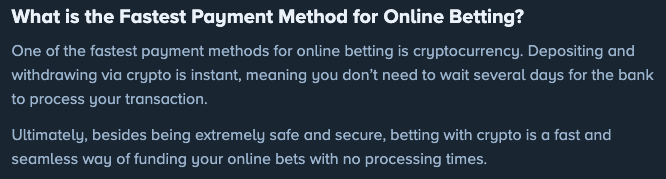
We tested USDT on TRC-20 at Stake. The other rankings rest on Stake's published fees. Compare other options in our guide to Tether casinos with fast withdrawals.
Deposits and Other Payment Methods
Outside direct crypto transfers, Stake offers two routes, and they work differently for cashing out.
The first is Buy Crypto in the Wallet, run by the outside providers MoonPay and Swapped. You pay by card, and the coins land in your Stake balance. It is a way in, not a way out: withdrawals still leave as crypto.
The second is local currency. Stake says that, in supported countries and currencies, Visa and Mastercard can be used for deposits and eligible withdrawals can be returned to the same card, taking up to three business days to reach the bank. The option appears only where your currency and location support it. Its terms require the same 100% deposit wagering before a fiat withdrawal.
If you hold only dollars and no crypto, you need an exchange to buy coins before depositing and to convert winnings afterward. The speed of that step depends on your exchange, not on Stake. Pick a coin and network your exchange supports in both directions.
Casino Experience
Stake.com is owned and operated by Medium Rare N.V., with its head office in Curaçao. Its terms state a Curaçao Gaming Authority license, number OGL/2024/1451/0918, and name payment subsidiaries in Cyprus.

The casino carries slots, live dealer tables and Stake Originals, its in-house games. Stake says its Originals are provably fair. Provably fair means each result can be checked afterward with a cryptographic record, so you can confirm it was not changed. Providers include Evolution, Pragmatic Play and Hacksaw Gaming. Stake also runs a sportsbook, poker and racing. Support is by live chat and support@stake.com.
| Offer | Stake's terms |
|---|---|
| Welcome offer | Rakeback of 3.5% of the house edge from your first bet |
| How to claim | Enter a valid affiliate code at signup or on the Offers page within 24 hours |
| Deposit bonuses | Offered through some affiliate codes; the wagering multiplier varies by offer |
| While wagering | The bonus currency stays locked and some games are excluded |
| Sportsbook contribution | $0.75 counted for every $1 wagered |
Stake pays rakeback as cash on every bet, claimable at any time from the VIP page, so it can be withdrawn like any other balance. Stake also runs weekly, monthly and drop bonuses; our crypto casino bonuses page covers the wider calendar.
Stake Smart offers daily deposit limits, loss and wager limits, product exclusions from 24 hours to indefinite, breaks of a day, week or month, and self-exclusion with a 6-month minimum. US readers can reach the National Problem Gambling Helpline at 1-800-GAMBLER, and our responsible gambling resources list more help.
Who Is Stake Best For?
Stake suits crypto players who prefer networks such as Tron or Solana and want casino games, sports betting and poker in one account. Its fixed withdrawal fees become proportionally less significant as the cashout amount increases.
It is a weaker fit for players making very small withdrawals, anyone who wants to avoid the possibility of KYC, or players in countries prohibited by Stake's terms. Our tested 518.20 USDT TRC-20 withdrawal reached our wallet in 2 minutes 25 seconds, but larger withdrawals may require manual processing. For alternatives, compare the best crypto casinos for instant withdrawals.
Bonuses from this casino
Welcome Bonus
200% up to $1,000
Min. deposit: $50
T&C apply · 18+
Pros & Cons
Pros
- USDT TRC-20 withdrawal approved in 32 seconds and in our wallet at 2 min 25 s
- No identity documents requested at signup or on our 518.20 USDT cashout
- No published maximum crypto withdrawal
- USDT on five networks: TRC-20, ERC-20, BEP-20, Polygon and Solana
- Published per-coin minimums and fees, from 2.50 USDT
- Provably fair Stake Originals, plus sportsbook and poker in one account
- Deposit, loss and wager limits, breaks and self-exclusion in Stake Smart
Cons
- Terms list the United States among prohibited jurisdictions
- Fixed withdrawal fee per coin, heavy on small cashouts and on Ethereum
- Each deposit must be wagered 100% before a crypto withdrawal
- KYC can be requested on any withdrawal, including proof of source of income
- Trustpilot reviewers describe account freezes and repeated document requests
- Curaçao license
Editorial verdict
Verdict
Stake delivered a fast result in our USDT TRC-20 withdrawal test. Our 518.20 USDT withdrawal was approved in 32 seconds and reached our wallet 2 minutes 25 seconds after submission, with no identity check. We received 517.20 USDT, matching Stake's published 1 USDT withdrawal fee. The main limitations are the 1x deposit turnover rule, KYC that can apply to any withdrawal, manual processing for larger cashouts and the United States on Stake's prohibited-country list. This result comes from one withdrawal on one account on September 2, 2026, and does not guarantee future payout times.
Frequently Asked Questions About Stake Casino
Which crypto is fastest for a small Stake withdrawal?
The fastest crypto for a small Stake withdrawal depends on fees as much as speed. Stake's published withdrawal fees are lowest on Solana, Tron and Litecoin, while USDT's flat 1 USDT fee takes a bigger share of a small cashout. Whichever coin you pick, network speed only matters after Stake approves the request; we measured USDT on TRC-20.
Why is my Stake withdrawal still pending?
A Stake withdrawal stays pending until Stake approves and sends it. Larger amounts may be processed manually, and an unbet deposit, unfinished bonus wagering or a document request can also hold it. Check your email and wagering progress, then look for a TXID in your transaction history, and contact live chat or support@stake.com if there is none.
Can US players use Stake.com?
US players are not permitted on Stake.com under its terms, which list the United States among prohibited jurisdictions. Stake.us is a separate sweepstakes site. An account opened from a prohibited country can be closed when documents are checked, and Stake's terms let it withhold winnings in that case.
How much does a Stake withdrawal really cost?
A Stake withdrawal costs a fixed fee per coin, deducted from your balance: 1 USDT for USDT, for example, as shown in Stake's help center in September 2026. A fixed fee costs 0.2% of a 500 USDT cashout and 10% of a 10 USDT one. Solana, Tron and Litecoin have the lowest published fees.
Is Stake licensed?
Stake.com is operated by Medium Rare N.V. under Curaçao Gaming Authority license OGL/2024/1451/0918. Stake's terms separately list the United States as a prohibited jurisdiction. Stake.us is a separate sweepstakes site and is not the casino reviewed here.
Do I need a code for the Stake welcome offer?
Yes, the Stake welcome offer needs a valid affiliate code, entered at signup or on the Offers page within 24 hours of opening your account. The offer gives you rakeback of 3.5% of the house edge from your first bet, paid as cash and claimable at any time from the VIP page.
We use funded accounts to request crypto withdrawals and record the amount, network, fees and conditions at the time of the test.
We timestamp casino approval, TXID issuance, blockchain confirmation and wallet credit to see where the payout time is actually spent.
We separate test results from cashier checks, operator information and player reports, so you know what each finding is based on.