A casino KYC check at withdrawal is an identity review the casino runs before it releases your money. It can ask for photo ID, proof of address, proof that you own the wallet or account you paid from and, on larger amounts, evidence of where your funds came from. Your withdrawal stays on hold until the review is finished.
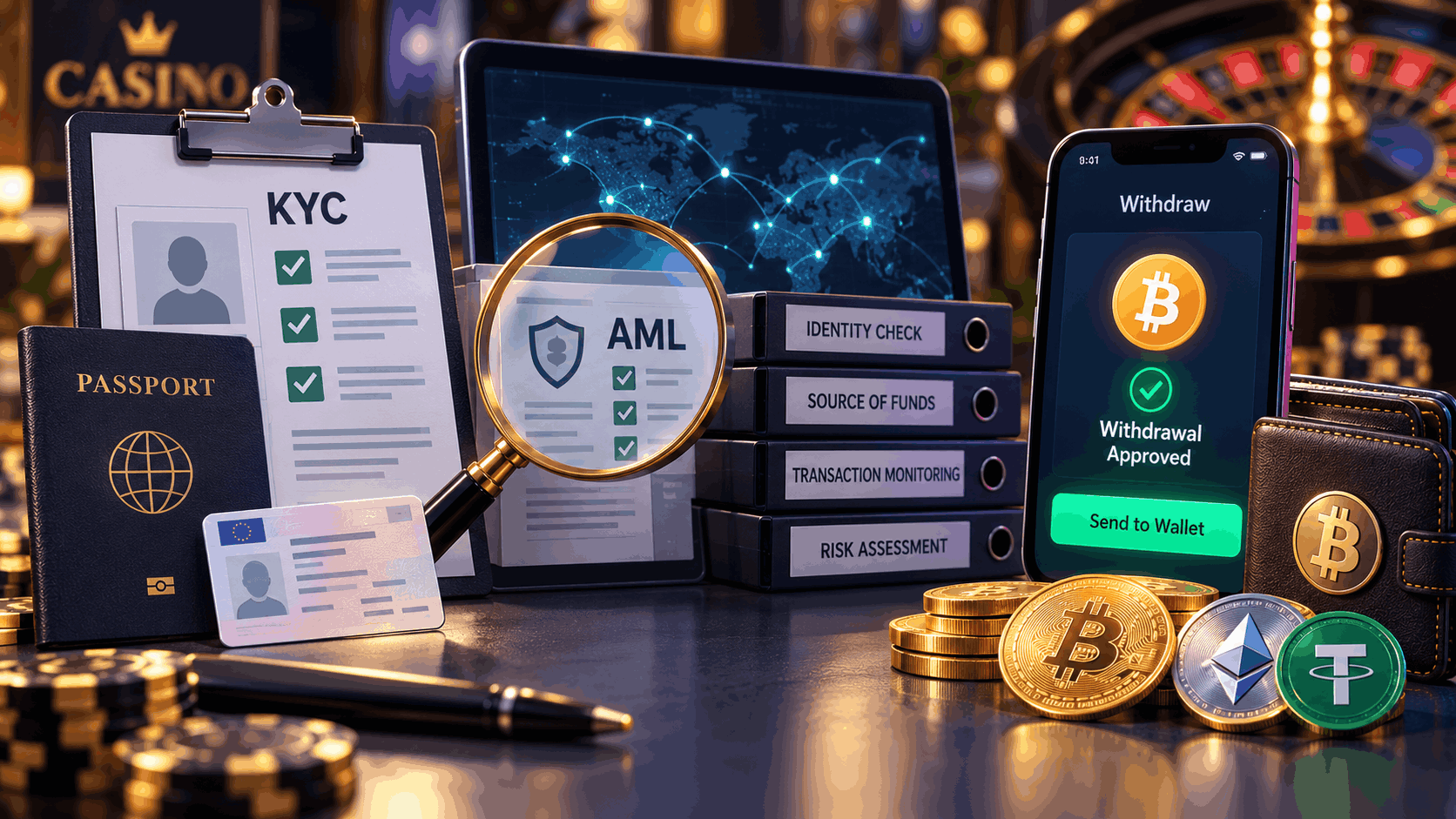
This guide covers what happens once a check has started: what you'll be asked for, why, and how to shorten the hold.
Why Casinos Verify Players at Withdrawal
Casinos may verify players before releasing a withdrawal to meet KYC, AML and security requirements. Licensed casinos may be required to carry out KYC and AML checks under their regulatory obligations, and operators can also run security and fraud checks under their own terms. That means a casino that allows registration or deposits without documents may still request verification before processing a withdrawal. Our no KYC online casino comparison sets out each casino's verification model.
A check can be triggered by a first cashout, a withdrawal threshold or a compliance or security review, depending on the operator and its rules. The verification models casinos use differ from one operator to the next, and whichever one applies, the steps that follow are the same. In our Mega Medusa review, ID and proof of address were required before the first payout.
Casino KYC Requirements: What You'll Be Asked For
A standard casino KYC request covers four things: who you are, where you live, that you are the person on the account, and that you own the payment method. Some casinos ask for all four at once, while others ask one at a time and wait for each reply. In our Ozwin Casino review, full verification was required before the payout.
Proof of identity
A passport, driver's license or national ID card, photographed in full with all four corners visible. The name and date of birth must match what you entered at registration. A document that has expired, or that is cropped or blurred, may be rejected and extend the verification process.
Proof of address
A utility bill, bank statement or government letter showing your name and home address. The casino's terms set how recent this document must be, so check that window before you upload. A screenshot of a banking app may be refused where the terms ask for a full statement.
A selfie or liveness check
A photo of you holding your ID, or a short video check through a verification provider. This confirms that the person submitting the documents is the account holder.
Proof of payment method or wallet ownership
For card deposits this is a photo of the card with the middle digits covered. For crypto it can mean a screenshot of your exchange account showing the deposit address and your name, or a signed message from a self-custody wallet. Casinos use this step to make sure withdrawals go to the person who funded the account.
Source of Funds and Source of Wealth Requests
A source of funds request asks where the money you deposited came from. A source of wealth request goes further and asks how you built your overall wealth. Casinos send these on large withdrawals, on high cumulative deposits, or when account activity doesn't fit what the casino knows about you. They sit on top of standard KYC, not in place of it.
For crypto deposits, transaction records can help document the route the funds took. An exchange statement shows the purchase of the crypto you deposited, and the exchange's withdrawal record matches that transaction to the casino's deposit address. A bank statement shows the transfer from your bank to the exchange, and payslips or tax documents show the income behind it. Together they can document the route from your income to the casino.
Source of wealth requests ask for broader evidence, such as employment income, business ownership, investment gains or an inheritance. If you've held crypto for years, the purchase records and on-chain history from that period become your main evidence. It is worth exporting that history from your exchange before you need it, because older records can be harder to retrieve later.
How AML Checks Work on Crypto Withdrawals
An AML check on a crypto withdrawal looks at how money moved through your account rather than at who you are. The casino's compliance team, or software it licenses, reviews your deposit and withdrawal pattern and the history of the wallets involved. It can hold your withdrawal while it does so, even if your identity is already verified.
The patterns that draw a review are the ones that look like money being moved rather than played with. Depositing and withdrawing with little or no play in between is the clearest example. Deposits from wallet addresses linked to mixers, sanctioned entities or reported fraud are another, as is withdrawing to a different wallet from the one you deposited from. Some casinos also charge a fee for this, covered in our guide to hidden casino withdrawal fees.
Account-level inconsistencies can also lead to additional checks, such as several accounts sharing a wallet, device or payment method, or a login location that doesn't match your registered country.
Wallet screening deserves particular attention for crypto players. Blockchain analytics tools score wallet addresses by their past contacts, so crypto that passed through a flagged address before it reached you can draw a review, even though you did nothing wrong. If a wallet-screening check is triggered, keeping exchange records and transaction details can make it easier to document where the funds came from.
An AML review is not an accusation. It is the casino recording that it checked. When a review closes, the casino releases the withdrawal, asks for source-of-funds evidence, or, if it finds a breach of its terms, restricts or closes the account.
What Happens to Your Withdrawal During a Review
During a KYC or AML review, your withdrawal stays in a pending or "under review" status and the money remains in the casino's hands until the review closes. Nothing has been sent to the blockchain yet, so there is no transaction ID to track. The review is the delay, and no network or coin choice speeds it up. Our guide to casino approval vs blockchain settlement explains the two stages.
How long a review takes depends on the casino and on how quickly you reply. Casinos that publish a verification timeframe in their terms state it in hours or business days. When a casino doesn't publish one, ask support for an expected date in writing, so you have something specific to refer back to. Our Cloudbet review shows the payoff of verifying early: the payout reached our wallet in 1 minute 19 seconds.
While a review is open, three actions can make it longer:
- Canceling the withdrawal to keep playing. Some casinos let you reverse a pending withdrawal. Doing so can restart the review when you request a new payout.
- Changing your withdrawal wallet mid-review. A new address during an open check is one of the patterns AML reviews look for.
- Opening a second account. Several accounts sharing a wallet or device is one of the patterns AML reviews look for, and it can turn a routine check into an account closure.
Some delays have nothing to do with verification: network congestion, a wrong network selection, or a missing memo tag. Our guide on network-side withdrawal delays covers those.
How to Get Through Verification Faster
The fastest way through casino verification is to have your documents ready before your first withdrawal and to keep every detail on the account consistent. A mismatch or an unreadable file adds a round of back-and-forth that the check itself doesn't need.
Register with your legal name and real address
Using a nickname or outdated address can create a mismatch when documents are requested.
Prepare your documents in advance
A valid photo ID and a proof of address inside the casino's recency window, both photographed clearly in full color.
Withdraw to the wallet or exchange account you deposited from
Where the casino supports it, withdrawing through the same wallet or payment route used for the deposit can make payment ownership easier to verify.
Keep your exchange records
Purchase and withdrawal history answers the standard source-of-funds questions without further back-and-forth.
Reply only through the casino's official support or verification portal
Never send documents to an email address or chat account you weren't directed to from the casino's own site.
Ask what is still outstanding
If the review stalls, ask support to confirm in writing which documents are still missing and when the review is expected to close.
When Verification Keeps Escalating
Escalating verification is when one request is followed by another after you've already complied: ID first, then proof of address, then bank statements, then a source-of-wealth declaration, with the withdrawal held throughout. Players report this pattern on public review and complaint platforms. It is the hardest version of a KYC check to deal with, because each new request can extend the wait. We keep player reports like these separate from our own withdrawal tests.
Legitimate escalation does happen, particularly on large withdrawals where source-of-funds rules apply. It becomes a problem when the requests have no clear link to the casino's published terms, or when documents you already supplied are rejected without a reason. If that happens, these steps put the dispute on record:
- Ask support which specific clause in the terms requires the new document.
- Keep copies of everything you sent and every reply, with dates.
- If the casino doesn't resolve it, raise a complaint with the authority that issued its license, using the license number shown in the casino's footer. Each licensing body sets its own complaints process.
Responsible Gambling
A withdrawal held for review can be a good moment to check that your play is still on your own terms. If you've been depositing again while a withdrawal sits pending, or chasing losses while you wait, deposit limits, session limits and self-exclusion tools are there for exactly that.
If gambling no longer feels like entertainment, free and confidential help is available independently of any casino. Our responsible gambling page lists the organizations that provide it.
Frequently Asked Questions About Casino KYC and AML Checks
What documents do casinos ask for during KYC?
Casinos ask for four kinds of documents during KYC: a valid photo ID, a proof of address dated within the casino's recency window, a selfie or liveness check, and proof that you own the card, wallet or exchange account you paid from. Larger withdrawals can add source-of-funds evidence such as exchange statements or bank records.
How long does casino KYC verification take?
Casino KYC verification takes as long as the casino's own review process plus the time it takes you to reply, and the timeframe is set by each operator, not by the blockchain. Casinos that publish a timeframe state it in hours or business days. Clear, matching documents sent in one go shorten the wait, while rejected files and follow-up requests extend it.
Can a casino hold my crypto withdrawal for an AML check?
Yes, a casino can hold your crypto withdrawal for an AML check, even after your identity has been verified. AML reviews look at transaction patterns and wallet history rather than identity, and the withdrawal stays pending until the review closes. When it closes, the casino releases the funds, asks for source-of-funds evidence, or acts on any breach of its terms it has found.
What is a source of funds request, and what can I send?
A source of funds request is the casino asking you to show where the money you deposited came from. Crypto players can answer it with exchange statements showing the purchase, exchange withdrawal records matching the casino deposit, and bank statements showing the transfer to the exchange. Payslips or tax documents cover the income behind it.
Why was I asked to verify again after already passing KYC?
You can be asked to verify again after passing KYC because verification isn't a one-time event: casinos recheck accounts when withdrawal amounts rise, when source-of-funds rules apply, when an ID document expires, or when an AML review flags new activity. A repeat request doesn't mean your earlier documents were rejected. Ask support which specific requirement triggered it.